Resurface Your Driveway This August Before Winter
A driveway that looks tired in August looks considerably worse in April. Long Island winters run pavement through dozens of freeze and thaw cycles, and every crack that goes into December open comes out the other side wider. Resurfacing closes that door while the weather still cooperates.
The catch is timing. Asphalt work has a season, and on Long Island it closes earlier than most homeowners expect.
What Driveway Resurfacing Actually Involves
Resurfacing means installing a new layer of hot asphalt, usually 1.5 to 2 inches thick, over your existing driveway. The old surface stays in place and becomes part of the structure.
It sits between two other options:
- Sealcoating applies a thin protective coating. It protects a sound surface and fixes nothing structural.
- Resurfacing adds new pavement. It corrects surface wear, minor cracking, and appearance.
- Full replacement removes everything down to the base and rebuilds. It corrects problems underneath.
Think of an overlay the way a dentist thinks about a crown. It works beautifully when the foundation below is healthy, and it fails quickly when it isn't. That's why an honest contractor spends more time looking at your base than at your surface.
Why August Is the Right Month for It
Hot mix asphalt earns its name. It leaves the plant somewhere around 300°F and has to be spread and compacted before it cools past the point where it can be worked properly.
Warm weather buys time and produces a better result:
- Slower cooling means better compaction. Warm ambient temperatures keep the mat workable long enough to roll it correctly, and compaction determines density, which determines lifespan.
- The bond sets properly. Tack coat between old and new pavement adheres best on a warm, dry surface.
- Plants are open. Asphalt plants across Long Island generally wind down between mid-November and spring. Once they close, resurfacing stops until the following season.
- Schedules aren't compressed yet. September and October fill up as homeowners rush ahead of the cold.
Resurface now and the new layer has months to cure and settle before it meets its first plow blade.
Is Your Driveway a Candidate for Resurfacing?

Not every worn driveway qualifies. The base underneath decides.
Resurfacing usually works when you see:
- Surface cracking that stays narrow and doesn't interconnect
- Faded, oxidized pavement with exposed stone
- Minor low spots that hold shallow water briefly
- General roughness with a firm, stable feel underfoot
- A driveway between roughly 10 and 20 years old
Full replacement is the better call when you see:
- Interconnected cracking in patterns across large sections
- Potholes that return after patching
- Areas that flex or feel spongy under a car tire
- Standing water that lingers for hours after rain
- Edges crumbling well into the driveway
Our post on when to repair versus resurface an asphalt driveway breaks down the middle ground in more detail.
What Winter Does to a Worn Surface
Skipping a season sounds harmless. Here's what actually happens between December and March.
- Water enters through cracks that look insignificant in August.
- It freezes and expands, widening those cracks from the inside with every cycle.
- The base loses fines as water moves through and carries material away, creating voids.
- Voids become depressions, then potholes once traffic starts working them.
- Plow blades catch raised edges and tear at pavement that's already weakened.
A driveway that needed a $ resurfacing in August frequently needs a full replacement two winters later. The material didn't change. The base did.
The Resurfacing Process Step by Step
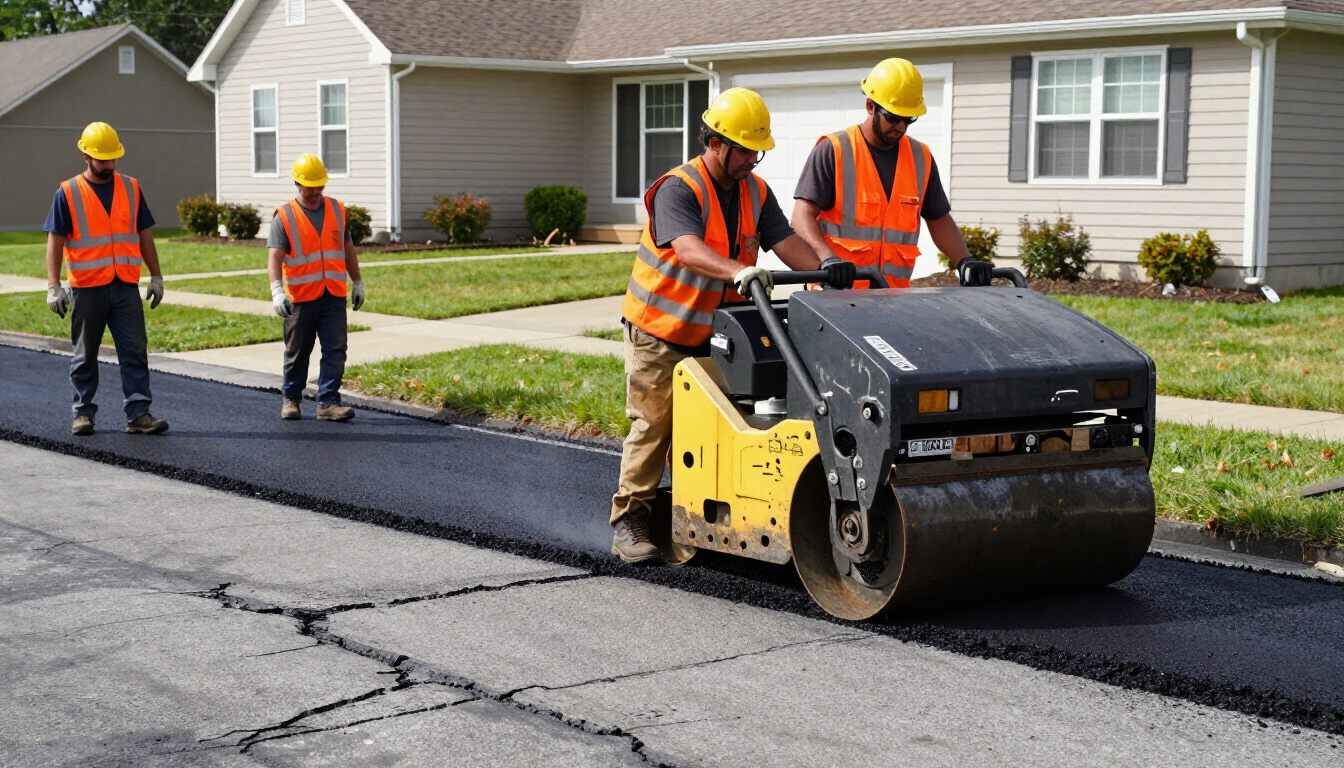
Most residential jobs in Medford finish in one day, sometimes two on larger driveways.
- Inspection and prep. The crew confirms the base is sound and identifies areas needing repair first.
- Cleaning. Debris, vegetation, and loose material get removed so the new layer bonds to solid pavement.
- Repairs. Deep cracks are filled and failed sections cut out and patched.
- Grade adjustment. Where needed, the transition at the garage and street apron gets addressed so the added height doesn't create a lip.
- Tack coat. A bonding agent is applied across the old surface.
- Paving. Hot asphalt is laid at consistent depth with a paver, then hand-worked at edges and transitions.
- Compaction. Rollers compact the mat while it's still hot, which is the step that determines how long the surface lasts.
Resurfacing vs Full Replacement
| Factor | Resurfacing | Full Replacement |
|---|---|---|
| Cost | Notably lower | Highest |
| Time on site | 1 to 2 days | 2 to 4 days |
| Fix base problems | No | Yes |
| Added lifespan | 8 to 15 years | 15 to 20 years |
| Driveway height | Rises 1.5 to 2 inches | Stays the same |
That last row matters more than it looks. Added height changes the relationship between your driveway, the garage floor, and the street apron, so those transitions need to be planned rather than discovered.
What to Expect After the Work Is Done
New asphalt needs a break-in period, and how you treat it in the first year affects how it ages.
- Vehicles can return after roughly 24 to 72 hours, depending on temperature and shade.
- Avoid sharp turns while parked for the first few months, since twisting tires scuff soft pavement.
- Keep point loads off it. Kickstands, trailer jacks, and ladder feet dent warm asphalt.
- Wait to sealcoat. New asphalt needs 6 to 12 months to cure before its first coat.
- Support the edges. Backfill with topsoil along the shoulders so the unsupported perimeter doesn't crumble.
Slight tire marks and minor scuffing during the first hot spell are normal. Our guide on how summer heat affects asphalt driveways explains what's expected and what isn't.
Book Your Medford Driveway Resurfacing This Month
The window between now and the end of paving season is shorter than it feels, and it closes for everyone at the same time. Homeowners who call in late October are usually calling to schedule for spring.
Stonerock Paving & Masonry has handled asphalt driveways, driveway paving in Medford, and paver driveways across Suffolk County for more than 30 years. We'll inspect the base, tell you plainly whether resurfacing is enough, and quote replacement only when it's genuinely the better value.
Request your free quote or call (631) 920-3618 while August dates are still open.
Related Articles
Frequently Asked Questions
How long does a resurfaced driveway last?
An overlay on a sound base typically adds 8 to 15 years of service life. Regular sealcoating, prompt crack filling, and good drainage push that figure toward the upper end of the range.
How many times can a driveway be resurfaced?
Usually once or twice. Each layer raises the surface height and adds weight over the original base, so a third overlay rarely performs well and full replacement becomes the more sensible investment.
Will resurfacing hide existing cracks permanently?
Cracks are repaired before paving, but wide or moving cracks can eventually reflect through the new layer. Proper preparation slows this considerably, and a failing base should be replaced rather than covered.
When does paving season end on Long Island?
Asphalt plants generally close between mid-November and spring, and cold weather makes proper compaction difficult before that. Most contractors stop scheduling residential resurfacing work sometime in late October or early November.
Can I resurface a concrete driveway with asphalt?
It is possible but rarely advisable for residential work. Concrete slabs move at their joints, and that movement reflects through asphalt as cracking within a few seasons of installation.
Our Recent Articles