Cracked, Settling, or Crumbling Stoops: When Repair Beats Replacement
Your front steps get walked on more than any other masonry on the property and inspected less than all of it. People notice a cracked patio because they sit on it. The stoop gets crossed twice a day by someone carrying groceries and looking at the door, not the treads.
By the time damage registers, homeowners usually want one answer: can this be fixed, or does the whole thing have to come out? The honest response depends on where the damage sits, and there are reliable ways to tell.
Why Stoops Fail Before the Rest of Your Masonry
Front steps take a combination of stresses that no other surface on the property deals with all at once.
Water Sits Where It Should Not
A stoop has horizontal treads that collect water, vertical risers that shed it, and joints running between them at exactly the elevation where water pools before it drains. Every one of those joints is an entry point.
Once water gets behind a tread or into a mortar joint, freeze-thaw cycles take over. Water expands as it freezes, pushes the material apart slightly, then thaws and leaves a slightly larger space to fill next time. Long Island runs through dozens of these cycles between December and March.
The Connection to the House Is a Natural Weak Point
Your home sits on a foundation extending below frost depth. A stoop, particularly one added after the house was built, often does not. When the ground moves seasonally, the two structures move independently.
That is why a separation gap between the stoop and the house wall is such a common sight. The gap itself is a symptom, and it is also an accelerant, since it channels water straight down alongside the foundation.
De-Icing Salt Does Real Damage
Chloride-based rock salt is hard on concrete and mortar. It increases the number of freeze-thaw cycles a surface experiences, and it works into the material where it contributes to surface scaling and spalling. Steps get salted more heavily than anything else on a property, because they are the one surface where slipping has immediate consequences.
Years of salting show up as a pitted, flaking surface that sheds material when you brush it with a shoe.

Reading the Damage
Different symptoms point to different problems, and the right fix follows from an accurate diagnosis rather than from the appearance of the damage.
| What You See | Likely Cause | Usually Addressed By |
|---|---|---|
| Crumbling mortar between stones or bricks | Weathering and freeze-thaw on joints | Repointing the affected joints |
| Surface flaking, pitting, or scaling | Salt exposure and surface wear | Resurfacing or veneer over sound structure |
| A single loose or rocking tread | Failed setting bed beneath that piece | Lifting and resetting the tread |
| Gap opening between stoop and house | Independent settlement of the stoop | Depends on how far it has moved |
| Wide crack running through the full structure | Structural failure or base movement | Usually replacement |
| Whole stoop tilted or sunk out of level | Inadequate footing or base failure | Replacement with proper footings |
| Steps at noticeably different heights | Settlement, or original construction | Assessment, often rebuilding |
Repairs That Genuinely Work
Where the underlying structure is sound, several repairs restore both appearance and function without replacing anything.
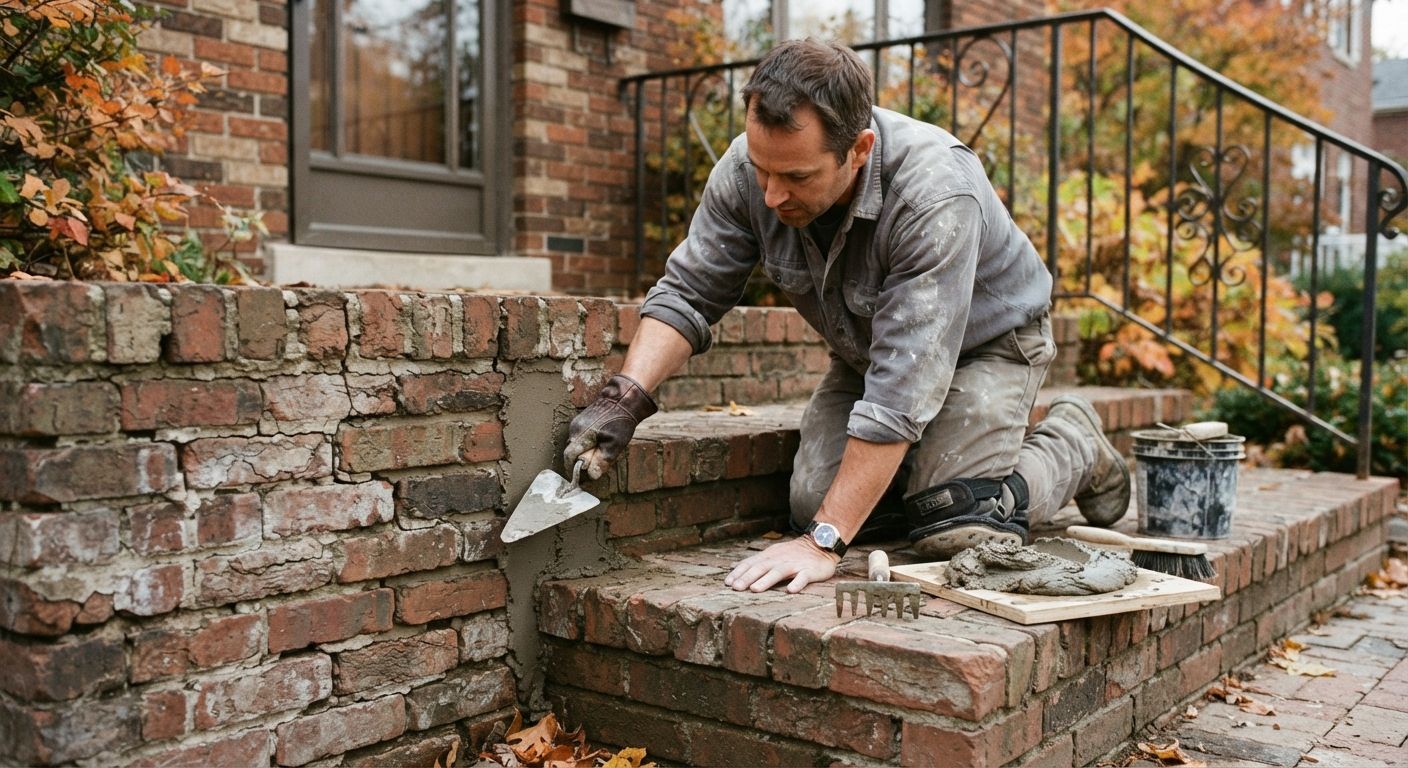
Repointing removes deteriorated mortar to a proper depth and replaces it with fresh mortar matched to the original. Done correctly it lasts for years. Done as a thin smear over failing joints it fails within a season.
Resetting individual pieces works when a bluestone tread or a paver has come loose but the mass beneath it is intact. The piece is lifted, the setting bed corrected, and the unit reset.
Resurfacing or veneering applies a new finished surface over a structurally sound but ugly stoop. A poured concrete stoop with heavy surface scaling can often be clad in stone or brick veneer, which changes the appearance completely at a fraction of replacement cost.
Partial rebuilding addresses the top course or the outer edge where damage concentrates, leaving the sound lower structure in place.
The condition all of these share is a sound core. Repairs applied over a failing structure buy a season and then reappear.
When Replacement Is the Better Call
Some situations do not reward repair spending, and recognizing them early prevents throwing money at a temporary result.
- Cracks running through the full depth of the structure rather than the surface
- The stoop has settled enough that it no longer meets the door threshold correctly
- Previous repairs have failed in the same location more than once
- The structure has separated substantially from the house
- Reinforcing steel is visible through spalled concrete, which means corrosion is already advancing
- Step heights vary enough to create a genuine trip hazard
- The stoop was built without footings and moves every winter
The last point deserves emphasis. A stoop poured on grade with no footing below frost depth will keep moving no matter what is done to the surface. Repairing it repeatedly costs more over a decade than rebuilding it properly once.
Safety Details Worth Checking
Stoops are the most common site of falls at a residence, and a few specifics matter more than appearance.
- Consistent riser heights. Codes generally allow only a small variation between the tallest and shortest riser in a flight. The human body climbs stairs from memory, and one step a half inch off is exactly what catches a toe.
- Handrails. Requirements commonly apply once a stair reaches four or more risers. Your local building department confirms what applies to your property.
- Tread pitch. Treads should shed water away from the house with a slight slope. A tread pitched backward holds water and ices over.
- Surface texture. A polished finish looks handsome and turns dangerous when wet or frosted.
If a repair or rebuild is happening anyway, correcting these at the same time costs little extra.
Why Fall Is the Right Time to Deal With It
Every mechanism damaging a stoop accelerates in winter. Water sits in open joints and freezes. Salt goes down weekly. Freeze-thaw cycles run repeatedly through the coldest months.
A crack that admits water in October is a wider crack by April. Repointing done in fall closes those entry points before the season that does the most damage. There is also a practical matter of working conditions, since mortar needs temperatures above freezing to cure properly, and that window narrows as the year closes.
The same reasoning applies to stoop and walkway installation generally. Masonry work goes better before the ground and the materials get cold.
Get Your Assessment Before Winter
Stonerock Paving & Masonry has been repairing and rebuilding steps, stoops, and entryways across Suffolk and Nassau County for more than 30 years. The team will tell you plainly whether repointing and resetting will hold or whether the structure has moved past the point where surface work makes sense, rather than quoting a full replacement by default.
The company handles stoop and masonry repair in Farmingville along with masonry services in Medford and masonry contractors in Holtsville and surrounding hamlets.
Call (631) 920-3618 or book a free stoop inspection before the weather turns.
Frequently Asked Questions
Can a cracked concrete stoop be resurfaced instead of replaced?
Often yes, when cracking is limited to the surface and the structure beneath is solid. Stone or brick veneer over a sound stoop changes its appearance entirely. Structural cracks running through the full depth need replacement instead.
Why is my stoop pulling away from the house?
The stoop is settling independently of the foundation, usually because it sits on shallower support. Small separations can be sealed. Larger movement means the stoop lacks adequate footings and will keep shifting until rebuilt.
Do I need a permit to replace a front stoop?
Requirements vary by municipality and by what the work involves. Like-for-like repairs often do not, while rebuilding, changing dimensions, or altering the entry may. Contact your local building department before scheduling the work.
Can stone veneer be installed over an existing concrete stoop?
Yes, provided the concrete is structurally sound and free of movement. The surface is prepared, and veneer is applied over it. This is a common way to update a serviceable but unattractive stoop without full demolition.
How long does stoop repair usually take?
Repointing and resetting individual pieces are often finished in a day or two. Full rebuilds involving demolition and new footings take longer, and mortar and concrete both need cure time before the steps carry normal traffic.
Our Recent Articles