Driveway Drainage Problems: What Standing Water Means Before Winter
A puddle on the driveway reads as a minor annoyance for most of the year. Something to step around on the way to the car. In October it is worth treating as information, because the same low spot holding water this week becomes a sheet of ice in January and an open pothole by April.
Driveways shed far more water than homeowners picture. An inch of rain falling on a 600-square-foot driveway produces roughly 370 gallons, and all of it has to go somewhere. When the surface does not direct it, the ground beneath takes it instead.
Why Standing Water Matters More Than It Looks
A driveway surface is only the visible layer. The real work happens underneath, and water is what undoes it.
Water Gets Into the Base
Every paved surface sits on compacted stone, and that base carries the weight. Water collecting on top eventually works through the surface or around its edges and saturates the material below.
Saturated base material loses its strength. The stone shifts rather than locking together, and the surface above begins to flex under vehicle weight. Flexing is what turns a hairline crack into an open one and a shallow depression into a deeper one, which collects more water and accelerates the whole process.
Winter Turns It Structural
Water in the base freezes, expands, and lifts the surface slightly. Then it thaws and leaves a void where the ice was. The surface drops back into that void, a little lower than before.
Repeat that through a Long Island winter and the low spot deepens measurably by spring. Potholes almost always begin as a drainage problem rather than a surface failure.
Where the Water Is Supposed to Go
A driveway is a sloped surface with a destination, even when it looks flat.
Properly graded driveways carry water away from the house and garage toward the street, a lawn area, or a drainage feature. The pitch required is slight, generally in the range of an eighth to a quarter inch of fall per foot. That is gentle enough to be invisible underfoot and enough to move substantial volume.
Water should never be directed toward the foundation, and the surface should not have interior low points where runoff collects instead of continuing on its way.
Common Causes on Long Island Properties

Drainage failures usually trace back to a handful of causes, several of which develop years after the driveway was built.
- Settlement creating a low spot. A section of base compacts further or washes out, and the surface follows.
- Insufficient original pitch. Driveways built close to level drain poorly from day one and worse as they age.
- Downspouts discharging onto paved surfaces. Roof runoff is concentrated and arrives fast, and a single downspout can deliver more water to one spot than the surface was built to handle.
- Landscaping raised over time. Added beds, new soil, or a patio built at a higher elevation can block the path water used to take.
- Apron settlement at the street. Where the driveway meets the road, settlement creates a basin that holds water at the lowest point.
- A neighboring property draining toward yours. Grade changes next door redirect water you never used to receive.
- Existing drains that stopped working. Catch basins fill with sediment and leaf litter, and a blocked drain performs like no drain at all.
Matching the Problem to the Fix
The right solution depends on what is actually happening, and these pair up predictably.
| What you are seeing | Likely cause | Usually addressed by |
|---|---|---|
| Puddle in the middle of the surface | Settled low spot or flat grading | Patching and regrading, or resurfacing with corrected pitch |
| Water running toward the garage | Negative pitch at the house end | Regrading, often with a channel drain at the threshold |
| Washed-out soil along the edges | Concentrated runoff with no defined path | Edge support plus redirecting the flow |
| Water pooling at the street apron | Settlement at the lowest point | Apron reconstruction |
| Ice forming in the same place each winter | Water collecting and sitting there | Fix the drainage, not the ice |
| Soggy ground beside the driveway | Runoff discharging into one spot | Dry well or redirected outlet |
| Standing water despite visible slope | Blocked or failed existing drain | Clearing or replacing the drainage system |
Solutions From Simple to Structural
Not every drainage problem needs excavation. Working up the scale saves money when a smaller fix is enough.
Redirect the Water First
The cheapest effective step is often moving roof runoff away from paved areas. Extending a downspout, adding an underground discharge line, or repositioning an outlet can resolve what looked like a driveway problem at a fraction of the cost.
Surface Regrading
Where the original pitch is poor but the structure is sound, resurfacing with corrected slope solves it. This works when the base is intact and the issue is purely geometry.
Channel and Trench Drains
A linear drain set across the driveway intercepts water before it reaches the garage. These suit situations where the land naturally falls toward the house and regrading alone cannot reverse it. They need periodic cleaning to keep working.
Catch Basins and Dry Wells
A catch basin collects water at a low point and pipes it to somewhere it can disperse. On Long Island that destination is commonly a dry well, a buried chamber surrounded by stone that lets water soak into the ground.
French Drains
A perforated pipe in a gravel trench intercepts subsurface water moving through soil. These address saturated ground beside or beneath a driveway rather than water sitting on the surface, so the diagnosis matters.
Permeable Paving
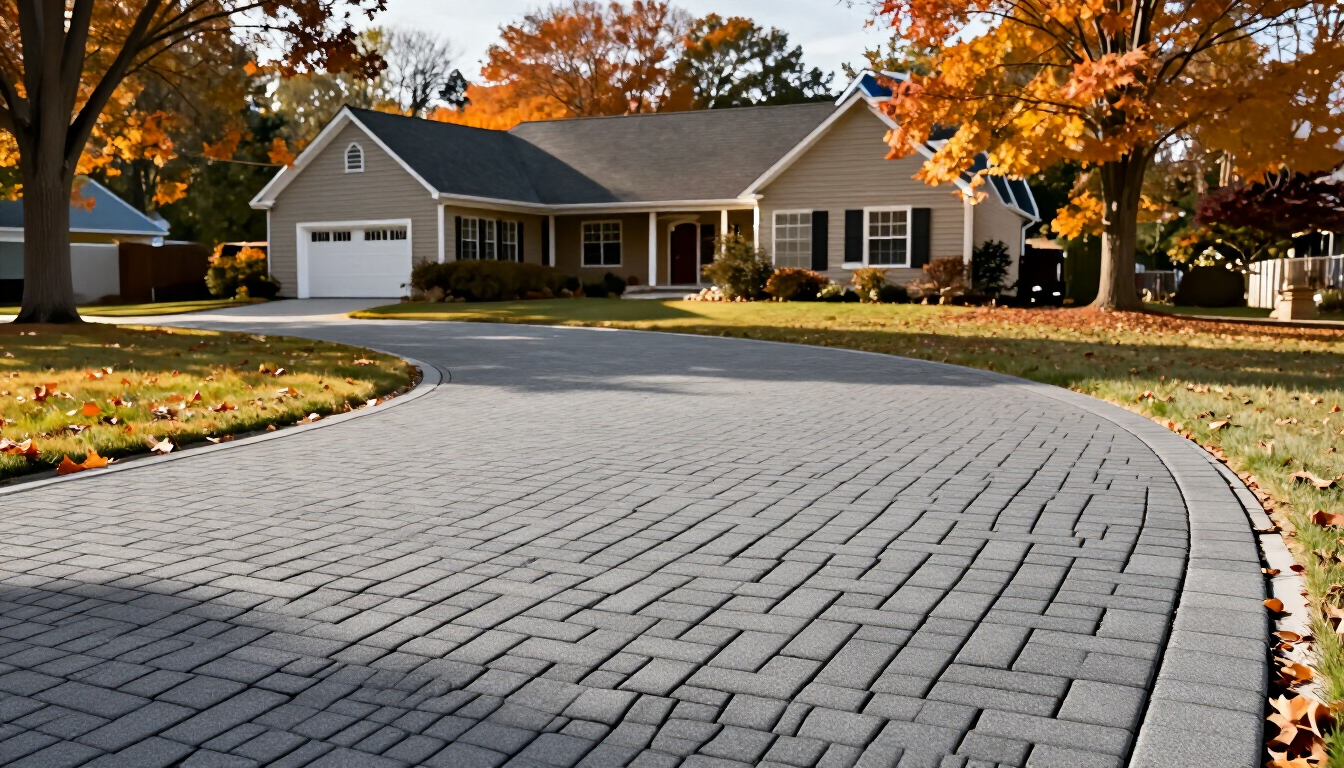
Permeable paver systems let water pass through the joints into an open-graded stone reservoir below. They handle drainage and surface duty together, though they require periodic cleaning to stay porous.
Full Reconstruction
When the base has failed across a wide area, rebuilding with correct pitch, proper base, and drainage designed in is the durable answer. Both asphalt driveway services and paver driveway construction can be built to solve drainage rather than ignore it, provided the grading is planned before anything goes down
Why Local Practice Favors Soaking Water In
Long Island handles stormwater differently from most of the region, and the reason sits underground.
The island draws its drinking water from an aquifer system beneath it rather than from upstate reservoirs. Local practice therefore leans toward returning rainwater to the ground on the property rather than piping it to the street. Sandy soil across much of Suffolk County suits that approach well, since water moves down through it readily.
For homeowners, the practical consequence is that a dry well is often a better solution here than it would be on heavier clay soil elsewhere. Whether it works on a specific property depends on soil conditions and the depth to groundwater, which is worth confirming before committing to one.

What Another Winter Costs
Leaving a drainage problem through the cold season rarely leaves it unchanged.
- Low spots deepen as freeze-thaw cycles work the base
- Cracks widen as water enters, freezes, and expands within them
- Edges continue eroding wherever runoff is concentrated
- Repeated ice in the same location becomes a genuine slip risk
- Repairs that would have been localized in October become broader by spring
The work itself also gets harder. Grading and base correction need workable ground, and that window closes as the season ends.
Get the Grade Assessed Before the Rain Turns to Ice
The Stonerock Paving & Masonry team has been correcting driveway grading and drainage across Suffolk and Nassau County for more than 30 years. The team looks at where water is coming from and where it needs to go before recommending anything, which often means the fix is smaller than homeowners expect.
We handle driveway paving in Bay Shore, paving services in Huntington, and surrounding communities.
Call (631) 920-3618 or arrange a free drainage assessment while the ground is still workable.
Frequently Asked Questions
How much slope does a driveway need to drain properly?
Generally an eighth to a quarter inch of fall per foot, which is gentle enough to be unnoticeable while still moving water effectively. Less than that and runoff tends to sit rather than travel toward its outlet.
Can standing water be fixed without replacing the driveway?
Often yes. Redirecting downspouts, adding a channel drain, or patching and regrading a settled area resolves many cases. Full replacement becomes the answer when the base has failed across a wide area rather than one spot.
Why does water run toward my garage?
The surface pitches the wrong way, either from original construction or later settlement. Where regrading cannot reverse the slope, a channel drain across the entrance intercepts water before it reaches the threshold.
Will a dry well work on my property?
It depends on soil conditions and how deep groundwater sits beneath you. Sandy soil across much of Suffolk County suits dry wells well, but the location needs assessing rather than assuming it will perform.
Is a puddle after heavy rain always a problem?
Not necessarily. Water clearing within a few hours is usually fine. Water still sitting a day later, or collecting in the same spot after every rain, indicates a grading or base issue worth investigating.
Our Recent Articles